Field Notes
Welcome to Good COP, Bad BOP - a compilation of Field Notes from real world, Energy Transition Infrastructure projects with Benjamin Galuza - a running record of implementable projects, fundable technologies, and the data that supports those decisions.
The Field Notes will codify themes and commonalities across projects. Including deep dives on hard tech, how the technology performs, and how it does or does not pass the CFO gate.
Field Notes Format: we'll frequently convene with guests and co-authors to gain additional perspectives, depth, and nuance.
A promise to our readers: No slop. No a.i. No click-bate. Unaveraged, humint straight to your inbox. You'll be the judge of whether the content is useful - or on its best days insightful. Your contact information and data will never be sold or shared with third parties. [Note: AI is used in the background for research, validation, tool development, and data visualizations - all sources and calculations are considered and verified individually by a human.]
Curating Feedback: We appreciate critique aimed at enhancing the resolution of a picture, pointing out what's missing from a distillation, and commentary on what needs to be added to our calculus. Positive friction is welcome - trolling and disrespectful content is not.
We're going to focus on three variables that make Energy Transition Infrastructure projects successful: performance, cost, and speed. Successful projects must clear technical hurdles and pass through financial gates - not one or the other, but both.
While it is not the focus of these writings, it is important to note, successful projects must also tell a compelling story to the people outside of the project team and gate committees. There are often faster, uglier, or disruptive - and therefor more economical paths - however, for social-political reasons those paths are not chosen, and are not capitalized. No one wants there name on an ugly product or bad experience.
So the name, why Good COP, Bad BOP? It's a play on "good cop, bad cop" - pushing a persona or idea to an extreme to test limits and shift our window of possibilities. In this case we want to examine, our points of view and ideas about Energy Transition Infrastructure - and while ideas or opinions seem sound at the surface. The turn here is that a Bad BOP instantly kills even the best of ideas for efficiency and potential margins. The two KPIs create an often unresolved tension between various gate keepers. The chief finance (economic) gate. The chief engineer (technical) gate. The ones with veto votes. We have to resolve these two variables to get to a COP and BOP with a shared overlap that meets the needs of the business TEA. There are many reasons to resolve this tension quickly and shut down the possibility of it playing out over quarters and years.
Some Definitions
COP = Coefficient of Performance - the value additive conversion of resource inputs to a "machine" into useful work out. A unit-less calculation; COP = useful work out / resources in (usually Useful Watts Out / Usable Watts In). It can be instantaneous peak, averaged, or annualized.
BOP = Balance of Plant - all the stuff that is *not* in the magic ("IP") box. This can be as narrow as lighting and fire protection systems or as broad as site development and utility interconnects. Depending on who's drawing the boundary and what needs to be capitalized.
TEA = Techno-Economic Analysis - (typically) a spreadsheet model with all the inputs and outputs of a business: the CapEx, OpEx, Revenue, and margins. All the cash-flows (time-bound with costs of capital) that enable a business to function, profit, and grow. Sometimes it's many stitched-spreadsheets. Lots of assumptions and clarifications. When done well, a TEA tells the founder or investor what must be true in order to earn a profit and unseat incumbents (who are likley and naturally climbing down the cost curve). Shayle Kann, Catalyst / Canary Media, Climatetech startups need strong techno-economic analysis, explains it better.
What I've been witnessing on our projects is that the finance team is engaged by the project team late in the conversation. And they are treated by the project team as the final gate. This is "right the wrong way 'round," British for bass-ackwards. Maybe we do this out of a belief that we know the obvious answer to our first question of the CFO, "how much do you want to spend on your infrastructure?" The answer is almost always, "zero"; or sometimes for the initiated CFO, "as a little as possible." The response many designers want to hear is, "millions of dollars, money is no object," in a cheery voice. Fortunately for businesses that never happens. Many of us would settle for any number at all. The initiated CFO, usually comes around and says, "what are my options and what happens if I do nothing?" To which, we go ask engineering.
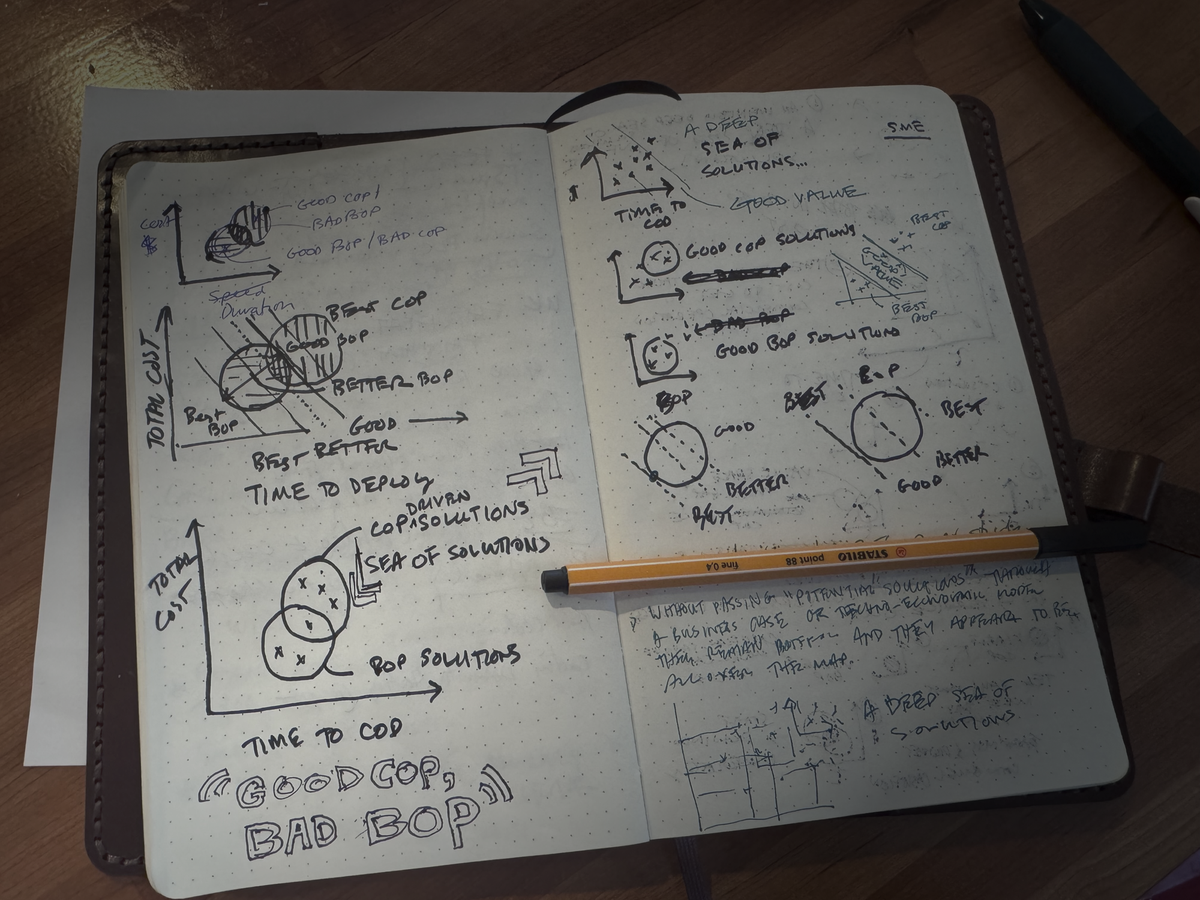
Engineering comes in, and from the surface they begin searching for the right technology and there appears to be an infinite sea of potential, technological solutions swimming along to choose from. So we cast nets and lines from the surface.
This is waste of time. Suit up and get underwater. The reality is that there is only a very specific and narrow set of solutions that can meet the proforma needs, and they're hiding, deep, down below the surface at the bottom of a mystical whirlpool of iteration. It's been our experience that we have to start drawing and costing in order to find the answer.
We've all seen owner-operator and investors fall into a trap of continuously hunting for BOPs that don't exist, burning valuable time, and momentum. We've seen engineers (or been one) feverishly chasing COPs that don't come close to meeting the needs of the proforma. Two worlds on opposite ends of a seesaw, backs turned away and ignoring each other... until one, without announcing their intent, silently gets off the seat at the bottom. Trust is gone. And still, we start over, and play again.
Good COP, Bad BOP will aim to shed light on this dilemma to find the overlap of BOP and COP solutions that owners ultimately choose from - and the data (and stories) that supported those decisions.
The thesis is simple: get finance and project teams together early with some options - when doing nothing is no longer an option - arm both sides with buckets of cold water and start quenching fiery, malleable steel. Trust that something durable and sharp will come out the other side.
We must accept that Energy Transition Infrastructure is unglamourous, infra after all is Latin for "beneath," meaning, it's so unattractive that we hide it from view. In walls. Under soil, lawns and pavement. The unfortunate reality is that it's expensive and its mission critical, whether you're a household, a business, a country or a global civilization.
One last thing before we go, a secret ingredient, if you can find it: project and program delivery teams need a charismatic S/EVP, C-level decider and champion who can tell the "big story" and chart the journey in our minds before we walk it. This provides the air cover for all the teams and gate keepers to take the risk of moving boldly into the future - where the data becomes irrelevant and our desired world springs to life thanks to the herculean efforts of the many and the few.
Stay tuned for Good COP, Bad BOP Field Notes on delivering Energy Transition Infrastructure.
We are still ramping up, meanwhile you can subscribe, if you'd like to stay up to date and receive emails when new content is published!